



Introducing Speech Therapy at Kansas City Psychology
Beyond the Diagnosis: How Speech Therapy, Occupational Therapy, and Psychology Work Together
At Kansas City Psychology, we believe that understanding an individual’s challenges is only the beginning. Meaningful progress comes from connecting that understanding with the right support, interventions, and treatment.
We are excited to announce that Kansas City Psychology is expanding to offer speech-language evaluations and therapy!
By bringing together psychological assessments, mental health services, occupational therapy, and speech-language therapy, we are creating a more comprehensive and collaborative approach to care.
Our goal is simple: To help individuals and families not only understand why challenges may be occurring, but also access the services and support needed to move forward.
Speech Therapy Is About More Than Speaking Clearly
When people think of speech therapy, they often picture helping children pronounce words correctly or overcome speech delays. While speech development is an important part of speech-language pathology, speech-language pathologists (SLPs) address a much broader range of communication needs.
Speech-language therapy can help individuals experiencing difficulties with:
- Expressive Language: Communicating thoughts, feelings, ideas, and needs.
- Receptive Language: Understanding spoken instructions, conversations, and complex information.
- Speech Sound Development: Producing sounds clearly and improving speech intelligibility.
- Social Communication: Understanding conversations, social expectations, and nonverbal communication.
- Language Processing: Understanding, organizing, and responding to verbal information.
- Communication Organization: Organizing thoughts, maintaining conversations, and explaining information clearly.
- Fluency: Addressing stuttering and disruptions in the flow of speech.
- Alternative and Augmentative Communication (AAC): Supporting communication through methods beyond spoken language.
These skills influence far more than conversation. Communication affects learning, relationships, emotional well-being, independence, and participation in everyday activities.
How Speech Therapy Supports Autism and ADHD
Communication differences are frequently associated with Autism Spectrum Disorder (ASD) and Attention-Deficit/Hyperactivity Disorder (ADHD), although they may appear differently across individuals.
Autism Spectrum Disorder
Some autistic individuals experience delays in spoken language, while others demonstrate advanced vocabularies and strong verbal abilities.
Even individuals with sophisticated language skills may experience challenges understanding implied meanings, interpreting social cues, participating in reciprocal conversations, or communicating during emotional or sensory overload.
Speech-language therapy can help autistic individuals strengthen language comprehension, develop functional communication skills, navigate social interactions, and advocate for their needs.
Treatment should respect individual communication styles while supporting greater confidence, independence, and meaningful participation in everyday life.
Attention-Deficit/Hyperactivity Disorder
Individuals with ADHD may struggle to organize their thoughts, remain on topic, follow lengthy verbal instructions, or communicate information in a clear sequence.
These challenges can affect classroom participation, workplace performance, and relationships.
When communication difficulties are present, speech-language therapy can help develop strategies for organizing verbal information, improving language comprehension, and strengthening conversational skills.
Coordinating speech-language therapy with psychological interventions can provide additional support for communication and executive functioning challenges.
Supporting Learning and Academic Development
Language development plays an essential role in reading, writing, and academic achievement.
Children with language difficulties may struggle with vocabulary, reading comprehension, written expression, or understanding classroom instructions. These challenges can sometimes overlap with learning disabilities, including dyslexia.
Speech-language evaluations can help identify underlying difficulties involving phonological awareness, language comprehension, vocabulary, and narrative organization.
Speech-language therapy can then target specific language skills contributing to academic difficulties.
For example, a student who can read individual words but struggles to understand passages may benefit from intervention targeting vocabulary, sentence comprehension, and making inferences.
When psychological and speech-language evaluations are combined, families and educators can gain a clearer understanding of how cognitive, language, and learning abilities interact.
The Connection Between Communication and Emotional Regulation
Communication and emotional functioning are closely connected.
When individuals have difficulty expressing their needs, describing emotions, or understanding others, frustration and emotional distress can increase.
A child who cannot clearly explain why a situation is upsetting may respond through crying, withdrawal, or challenging behaviors. An adolescent who struggles to communicate with peers may experience social anxiety or reduced confidence.
Speech-language therapy can help individuals develop more effective ways to communicate emotions, ask for assistance, express needs, and advocate for themselves.
When combined with psychological therapy, these strategies can support emotional regulation, coping skills, and healthier interpersonal relationships.
By addressing both communication and emotional needs, treatment can become more individualized and meaningful.
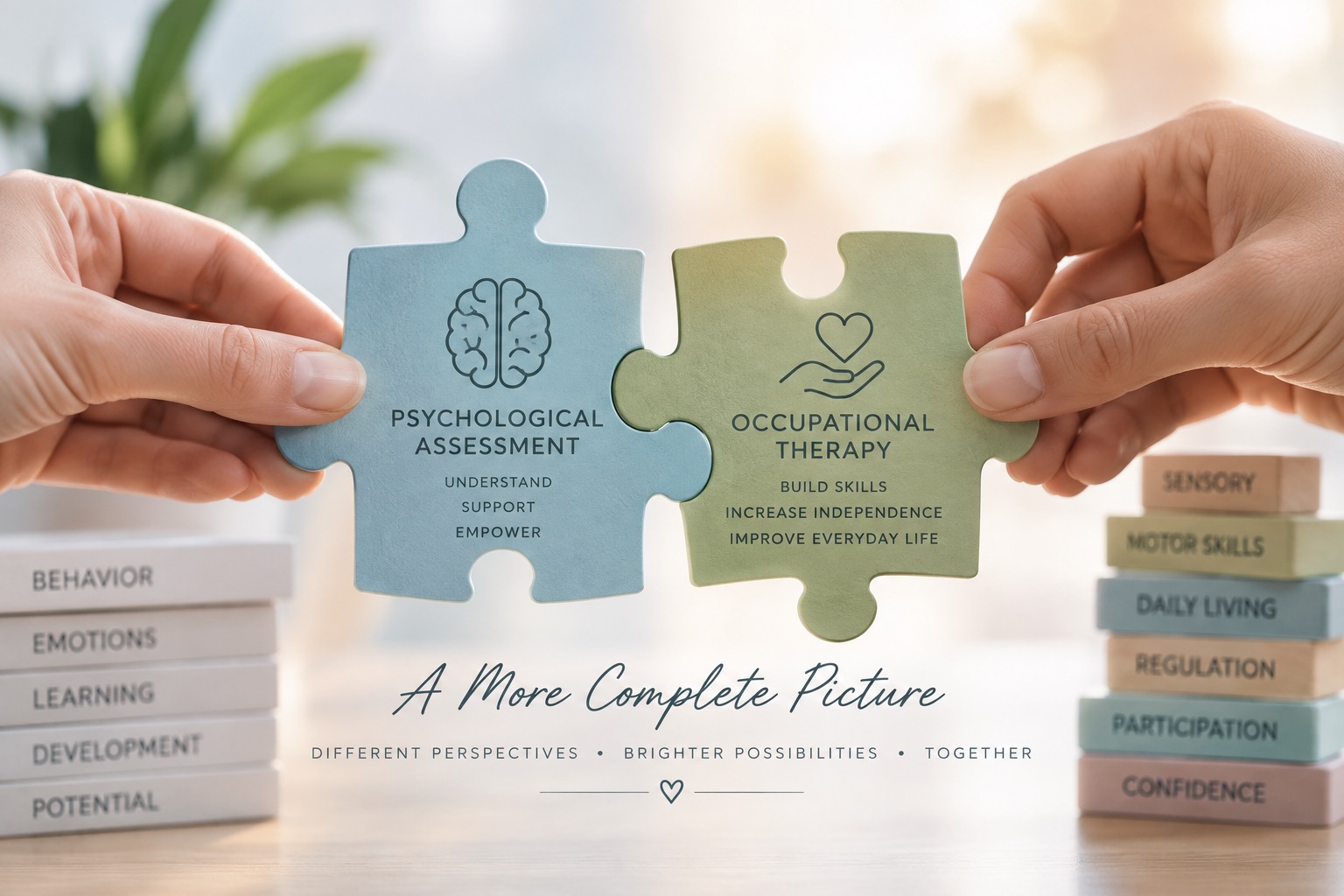
How Speech, Occupational Therapy, and Psychology Work Together
One of the most exciting aspects of expanding our services is the opportunity for collaboration across specialties.
At Kansas City Psychology, we recognize that communication, sensory processing, emotional regulation, executive functioning, and cognitive development are closely connected.
Each specialty contributes a different perspective.
Psychological Services: Understanding the Why
Psychological evaluations help identify cognitive, emotional, behavioral, developmental, and learning patterns.
Psychological therapy provides support for anxiety, depression, emotional regulation, behavioral concerns, and other mental health needs.
Occupational Therapy: Supporting Everyday Functioning
Occupational therapy focuses on developing skills that support independence and participation in daily activities.
Treatment may address sensory processing, emotional regulation, motor coordination, executive functioning, and daily living skills.
Speech-Language Therapy: Strengthening Communication
Speech-language therapy helps individuals understand and express language, develop speech skills, improve functional communication, and participate more effectively in everyday interactions.
Consider a child who becomes overwhelmed during classroom activities.
A psychological evaluation may identify ADHD or anxiety. Occupational therapy may reveal sensory processing difficulties, while speech-language testing may identify challenges understanding verbal instructions or expressing needs.
By working together, these specialties can develop coordinated strategies addressing the child’s communication, regulation, and learning needs.
Rather than treating each challenge separately, this collaborative approach helps us understand how different areas of functioning influence one another.
From Evaluation to Treatment: Closing the Gap
One of the challenges families frequently encounter is the gap between receiving a diagnosis and accessing appropriate treatment.
A psychological evaluation may identify autism, ADHD, a learning disability, or another developmental concern. However, families are often left searching for additional providers who can address the specific needs identified during testing.
Our expansion into speech-language therapy is designed to help reduce that gap.
When communication needs are identified during a psychological evaluation, families may have the opportunity to access additional speech-language assessment and treatment within the same practice.
Similarly, individuals seeking speech-language therapy may benefit from psychological or occupational therapy services when additional developmental, emotional, or functional concerns are identified.
Not everyone requires multiple services. Our goal is to identify the supports most appropriate for each individual and provide opportunities for coordinated care when beneficial.
We want families to move beyond receiving answers and toward receiving meaningful support.
A New Chapter at Kansas City Psychology
The addition of speech-language evaluations and therapy represents another important step in the continued growth of Kansas City Psychology.
Our mission has always been to help individuals and families better understand their cognitive, emotional, behavioral, and developmental needs.
As our practice expands, that commitment remains unchanged.
By bringing psychological services, occupational therapy, and speech-language pathology together, we are creating more opportunities for comprehensive evaluations, individualized treatment, and collaboration across specialties.
Whether someone is seeking answers through psychological testing, needs direct speech-language therapy, or would benefit from occupational therapy, our focus remains on understanding the whole person and building on individual strengths.
Different Expertise. One Shared Mission. More Ways to Help.
Ready to Learn More About Speech Therapy?
Are you concerned about your child’s speech development, language comprehension, social communication, or ability to express thoughts and needs?
Are you wondering whether communication challenges may be connected to autism, ADHD, learning differences, or other developmental concerns?
Kansas City Psychology is expanding its services to include speech-language evaluations and therapy alongside comprehensive psychological assessments, mental health services, and occupational therapy.
Contact Kansas City Psychology to learn more about our expanding services and appointment availability.