



When a child, teenager, or adult is struggling with attention, sensory sensitivities, emotional regulation, coordination, school performance, or everyday routines, it is not always easy to determine where the difficulty begins—or what type of support will make the biggest difference.
At Kansas City Psychology, we believe that understanding the whole person is an important part of providing effective care. That is why we are excited to expand our services to include Occupational Therapy (OT) alongside our psychological and diagnostic assessment services.
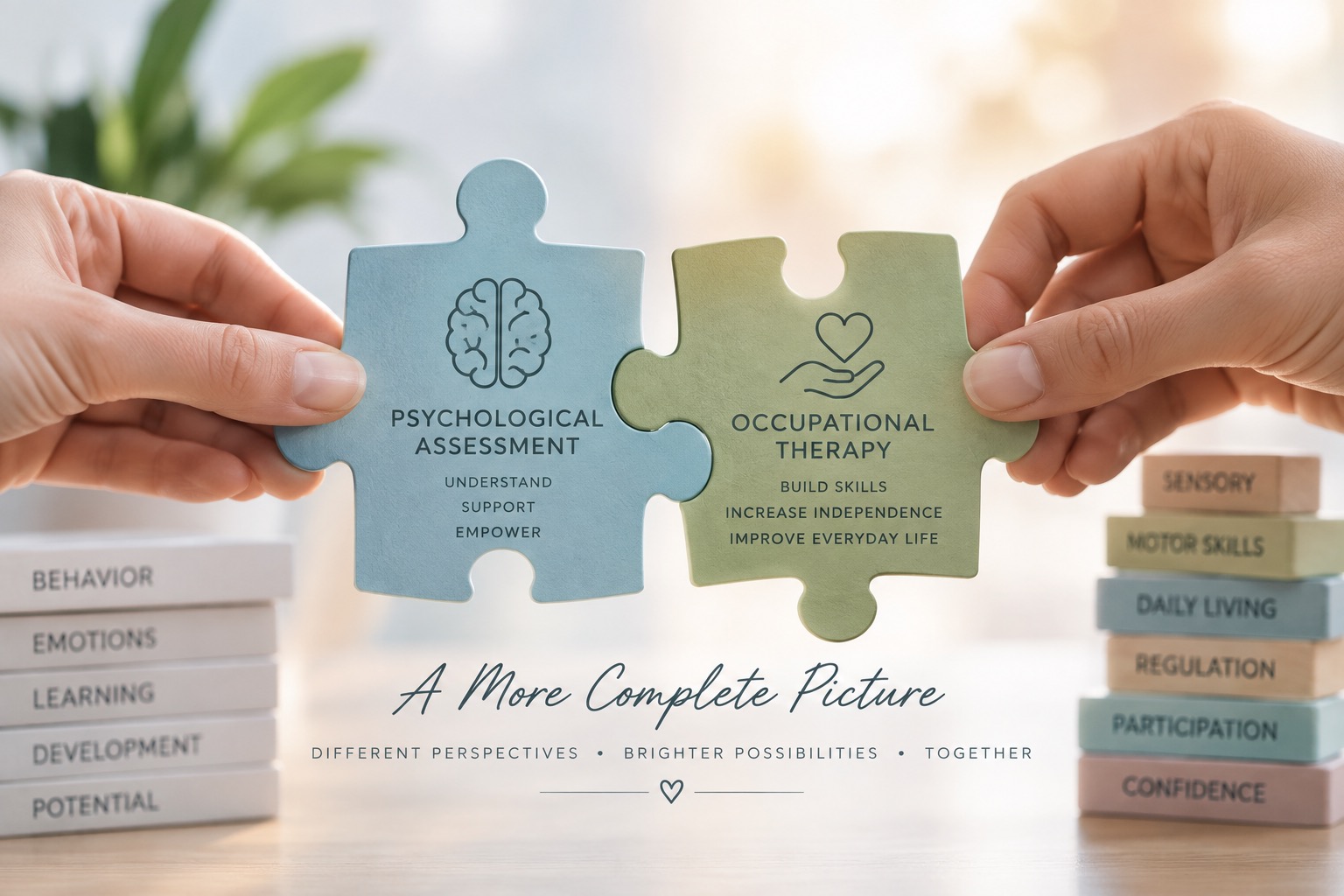
By bringing psychological assessment and occupational therapy together, we can move beyond simply identifying a diagnosis. We can better understand how a person’s neurological, cognitive, emotional, sensory, and functional needs interact in everyday life—and develop practical strategies to help.
Psychological Testing Helps Answer “Why?”—OT Helps Address “How?”
A comprehensive psychological evaluation can help identify and understand conditions such as:
- Autism Spectrum Disorder
- ADHD
- Learning Disorders
- Anxiety and mood disorders
- Executive functioning difficulties
- Intellectual and developmental disabilities
- Trauma-related concerns
- Behavioral and emotional difficulties
Psychological testing can provide valuable information about a person’s cognitive abilities, attention, memory, executive functioning, academic skills, emotional functioning, social development, and behavior.
But receiving a diagnosis is often only the beginning.
Families frequently leave an evaluation with another important question:
“Now that we understand what is happening, what can we do to help?”
This is one area where occupational therapy can become an important part of the next step.
What Does an Occupational Therapist Do?
Occupational therapy helps people participate more successfully and independently in the activities—or “occupations”—that make up everyday life.
For children, these occupations may include getting dressed, eating, playing, writing, attending school, completing homework, managing transitions, interacting with others, and regulating emotions.
For adolescents and adults, OT may address independence, organization, sensory regulation, daily routines, work or school functioning, self-care, executive functioning, and participation in the community.
Depending on an individual’s needs, occupational therapy may help with areas such as sensory processing and regulation, fine motor skills, handwriting, coordination, motor planning, emotional regulation, executive functioning, daily living skills, feeding-related concerns, routines and transitions, attention and task completion, and independence.
The goal is not simply to improve a skill during an appointment. OT focuses on helping those skills translate into real-world functioning at home, school, work, and in the community.
Occupational Therapy and Autism
For many autistic individuals, differences in sensory processing and regulation can have a significant effect on everyday life.
Sounds that others barely notice may feel overwhelming. Certain clothing textures may be extremely uncomfortable. Busy classrooms or stores can become exhausting. Changes in routine may be difficult to manage. Some individuals may actively seek movement or sensory input, while others may avoid particular sensations.
These experiences can sometimes be misunderstood as behavioral problems when the person may actually be experiencing sensory overload, difficulty regulating their nervous system, or challenges communicating what they need.
Occupational therapy can help identify these patterns and develop individualized strategies to support regulation and participation.
For an autistic child, OT might focus on tolerating everyday sensory experiences, developing fine-motor or self-care skills, improving transitions, participating more comfortably in classroom activities, or developing strategies for emotional and sensory regulation.
For adolescents and adults, OT can also address independence, routines, organization, sensory needs at school or work, daily living skills, and strategies for managing environments that contribute to overwhelm or fatigue.
The goal is not to change who an autistic person is. The goal is to understand their individual needs, build useful skills, modify environments when appropriate, and help them participate more comfortably and independently in everyday life.
Occupational Therapy and ADHD
ADHD affects much more than the ability to “pay attention.”
Individuals with ADHD may experience difficulty beginning tasks, estimating time, organizing materials, remembering multiple steps, transitioning between activities, regulating emotions, maintaining routines, or completing tasks even when they understand exactly what needs to be done.
Occupational therapy can help turn the information identified during an ADHD evaluation into practical strategies.
An OT may work with an individual to develop systems for organization, create more effective routines, break complex activities into manageable steps, identify environmental distractions, develop sensory or movement strategies, and strengthen skills needed for greater independence.
For a child, that might mean developing a morning routine that actually works.
For a teenager, it could mean learning strategies for organizing assignments and managing transitions between classes and activities.
For an adult, it might involve developing realistic systems for managing work responsibilities, household tasks, schedules, and everyday demands.
When Psychological Evaluation and OT Work Together
One of the advantages of offering psychological assessment and occupational therapy within the same multidisciplinary practice is the ability to look at concerns from different—but complementary—perspectives.
Consider a child who struggles to remain seated in class, becomes upset during transitions, avoids writing assignments, and has frequent emotional outbursts.
A psychological evaluation may help determine whether ADHD, autism, anxiety, a learning disorder, or another condition contributes to those difficulties.
An occupational therapy evaluation may provide additional information about sensory processing, fine-motor abilities, motor planning, regulation, and the functional demands of the child’s everyday environment.
Together, this information can provide a much more complete picture.
Rather than asking only, “What diagnosis does this person have?”, a multidisciplinary approach allows us to ask:
What is making everyday life difficult, what strengths can we build upon, and what supports are most likely to help?
Assessment Should Lead to Action
A psychological diagnosis can provide clarity and validation. It can help families understand behaviors that may have been confusing for years and can support accommodations or services at school, college, or work.
But the greatest value often comes from determining what to do with that information.
When appropriate, occupational therapy can help translate evaluation findings into practical intervention. Recommendations from psychological testing can inform treatment goals, while observations during OT can provide additional insight into how an individual functions outside of standardized testing situations.
This collaborative approach can be particularly valuable for individuals with autism, ADHD, developmental differences, executive functioning difficulties, sensory concerns, learning challenges, and emotional or behavioral regulation difficulties.
Expanding Care at Kansas City Psychology
We are excited to welcome Occupational Therapy services to Kansas City Psychology as part of our continued growth into a multidisciplinary practice.
Our goal is to make it easier for individuals and families to move from questions, to understanding, to practical support without feeling as though they have to navigate every step on their own.
Whether someone already has an autism or ADHD diagnosis, recently completed a psychological evaluation, or simply has concerns about sensory processing, motor skills, regulation, independence, or everyday functioning, an occupational therapy evaluation may help determine whether OT services could be beneficial.
At Kansas City Psychology, we want evaluations to do more than provide a diagnosis.
We want them to help create a roadmap forward.
Interested in Occupational Therapy or Psychological Assessment?
Kansas City Psychology provides psychological assessment and occupational therapy services for children, adolescents, and adults in the Kansas City area.
If you are wondering whether psychological testing, occupational therapy, or a combination of services may be appropriate, contact Kansas City Psychology to learn more about our services and scheduling options.