

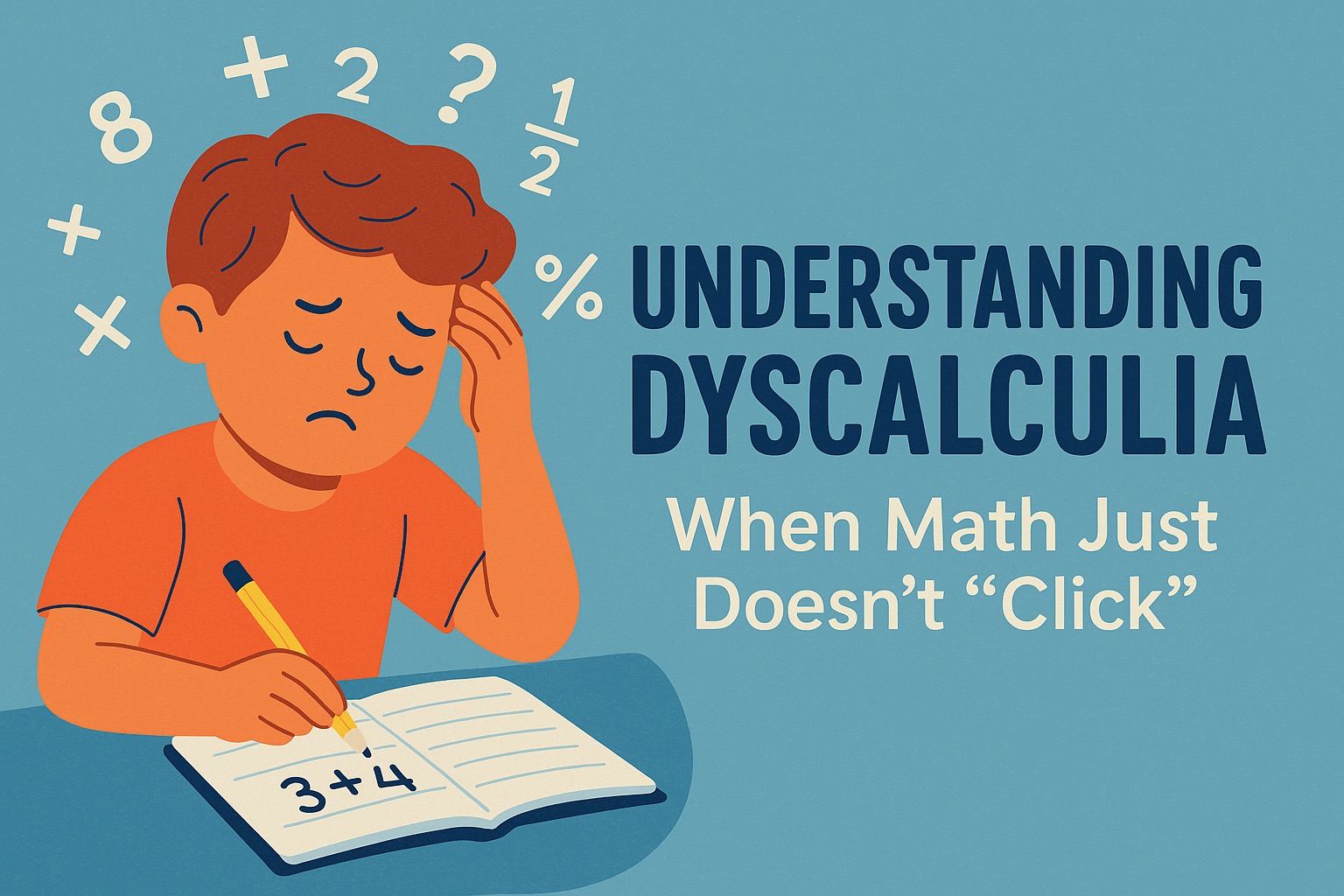


If you’ve noticed your child struggling with math far beyond what seems typical—confused by counting, overwhelmed by simple calculations, or anxious at the sight of numbers—you’re not alone. These struggles may be more than just a dislike of math; they could be signs of dyscalculia.
Dyscalculia is a specific learning disability that affects a person’s ability to understand numbers and math concepts. Just like dyslexia impacts reading, dyscalculia affects numerical reasoning and arithmetic, even though intelligence is otherwise normal. It’s estimated that about 5% of children and adults have dyscalculia—roughly one to two students in every classroom. Unfortunately, many go undiagnosed for years, which can lead to frustration, avoidance of math, and a loss of confidence in school.
How Dyscalculia Shows Up in School
For children and teens, dyscalculia can make school feel like an uphill battle. Math builds on itself, so if a child struggles with early number concepts—like understanding that “5” represents a quantity—they often fall further behind as topics become more complex.
Students with dyscalculia may struggle with:
-
Learning and recalling basic math facts (addition, subtraction, multiplication tables)
-
Understanding place value and number sense
-
Telling time, reading charts, or following multi-step directions
-
Completing word problems or applying math concepts to real-life situations
The impact goes beyond grades. Repeated failures can create math anxiety, avoidance behaviors, and lower self-esteem. Teens may begin saying things like “I’m just not a math person,” which can limit their willingness to take higher-level math and science courses—closing doors to future opportunities.
Dyscalculia in Adulthood
Dyscalculia doesn’t go away with age—it’s a lifelong difference. Adults may continue to struggle with:
-
Budgeting and financial planning
-
Calculating tips or change
-
Managing schedules and time estimates
-
Understanding measurements or data
These challenges can create stress at work, particularly in jobs requiring quick mental math or number analysis. Some adults even avoid number-related tasks altogether, which can limit career options and impact earning potential.
Receiving a diagnosis later in life can be empowering. Many adults report feeling relieved to finally have an explanation for their lifelong struggles, which opens the door to learning strategies, workplace accommodations, and practical tools for daily life.
What Helps: Evidence-Based Support
The good news is that with the right support, individuals with dyscalculia can make real progress. Some of the most effective strategies include:
-
Structured, multisensory math instruction – Breaking concepts into small, clear steps while using visuals, hands-on materials, and real-world examples.
-
Game-based and low-pressure practice – Making math practice engaging and anxiety-free to build fluency.
-
School accommodations – Extra time on tests, calculators, step-by-step instruction, and quiet environments can reduce pressure and allow students to demonstrate what they know.
-
Assistive technology – Tools like budgeting apps, graphing software, and talking calculators can reduce frustration and support independence.
Why a Formal Evaluation Matters
A psychoeducational evaluation can be a turning point. Formal testing helps identify whether dyscalculia is present and maps out learning strengths and weaknesses. This data is crucial for creating a personalized plan for success—whether that’s an IEP or 504 plan in school, accommodations for college entrance exams, or workplace supports under the ADA.
Perhaps most importantly, a diagnosis can bring validation and relief. Parents often feel empowered knowing their child’s struggles have a name, and children gain hope that with the right tools, math doesn’t have to feel impossible.
Final Thoughts
If your child is consistently struggling with math despite putting in effort, trust your instincts. Early intervention makes a difference. Seeking an evaluation can be the first step toward understanding what’s really going on and helping your child thrive.
Dyscalculia is not a reflection of intelligence or potential—it’s simply a difference in how the brain processes numbers. With the right support, kids (and adults) with dyscalculia can gain confidence, master essential skills, and succeed in school, work, and life.